
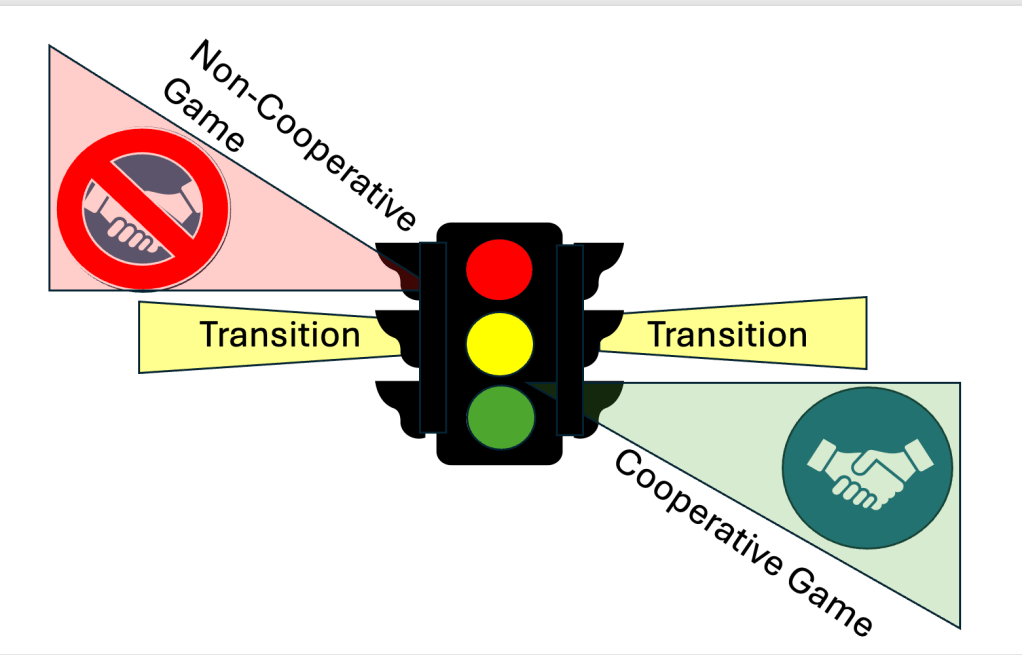
Dr Mac’s Traffic Light Model
A Three-Variable Framework for Understanding Decision-Making
Scroll down to access the model
Every decision contains three variables: Currency, Hubris, and Duress.
All three are present in every decision, but one usually becomes dominant.
Dr Mac’s Traffic Light Model is a decision-analysis framework designed to identify the dominant force shaping human choices. It helps explain when people cooperate, compete, comply, overreach, resist, or make irrational decisions.
The Three Variables (Currency, Hubris, Duress)
Currency
Currency represents value. It includes anything a decision-maker can gain, preserve, exchange, invest, or leverage.
Currency may include:
- Money
- Time
- Information
- Reputation
- Relationships
- Authority
- Opportunity
- Social capital
Currency-dominant decisions are usually rational, strategic, and value-seeking.
Core question:
“What do I gain, preserve, exchange, or leverage?”
Hubris
Hubris represents pride-driven judgment. It occurs when a decision-maker believes their experience, intelligence, authority, or intuition is superior without sufficient evidence.
Hubris may include:
- Overconfidence
- Confirmation bias
- Ignoring research
- Rejecting expert advice
- Assuming one’s judgment is optimal
- Believing normal limits do not apply
Hubris-dominant decisions are often irrational because pride replaces evidence.
Core question:
“Why should my judgment prevail over evidence?”
Duress
Duress represents pressure, threat, fear, or coercion. It exists whenever a person acts to avoid a negative consequence.
Duress may range from mild inconvenience to fatal danger.
Examples include:
- Embarrassment
- Conflict
- Social rejection
- Financial loss
- Legal consequences
- Physical harm
- Threats of violence
- Death
Duress-dominant decisions are driven by avoidance, protection, compliance, or survival.
Core question:
“What negative consequence am I trying to avoid?”
How the Model Works
In every scenario, the analyst asks:
- What signs of Currency are present?
- What signs of Hubris are present?
- What signs of Duress are present?
- Which variable appears dominant?
- How do the other two variables still influence the outcome?
The model does not assume that one behavior has only one explanation. The same action may be rational, pride-driven, or fear-driven depending on the motive behind it.
Example Scenario
A new couple discusses celebrating birthdays and holidays together. One partner strongly believes that no birthday or holiday should ever be missed and expects the other partner to attend all of them. The other partner complies.
| Currency | Hubris | Duress |
|---|---|---|
| Preserving relationship value | Belief that one’s view of relationships is correct | Fear of disappointing the partner |
| Building trust | Assuming personal expectations should govern both people | Fear of conflict |
| Investing in emotional goodwill | Dismissing alternative views of holidays | Fear of rejection |
| Strengthening commitment | Treating preference as a rule | Fear of guilt or consequences |
| Maintaining reciprocity | Believing attendance is self-evidently required | Pressure to comply |
Determining the Dominant Variable
Currency-Dominant Interpretation
The person complies because attending birthdays and holidays is viewed as an investment in the relationship.
Hubris-Dominant Interpretation
The demanding partner believes their personal standard is unquestionably correct and should control the relationship.
Duress-Dominant Interpretation
The complying partner attends because the consequences of not attending feel worse than attending.
Why the Model Matters
Dr Mac’s Traffic Light Model can be used to analyze decisions in:
- Relationships
- Leadership
- Negotiation
- Economics
- Politics
- Conflict resolution
- Organizational behavior
- Ethics
- Public policy
- Game theory
- Crisis decision-making
The model helps distinguish between decisions made for value, decisions made from pride, and decisions made under pressure.
The Central Insight
A decision may appear simple on the surface, but beneath it are three competing forces:
Currency asks: What is valuable?
Hubris asks: Whose judgment dominates?
Duress asks: What threat must be avoided?
The dominant variable reveals the true driver of the decision.
Access The Model on GPT
Dr. Mac’s Traffic Light Model: (Currency, Hubris, and Duress) in Decision-Making:
//chatgpt.com/g/g-6a32d48c02508191895c3fdccc0f4fef-dr-mac-s-traffic-light-decision-models
Model Link:
Dr Mac’s Traffic Light Model explains decision-making through three variables: Currency, Hubris, and Duress. The model identifies whether decisions are driven by value, pride, or pressure.

